


Article: Summer Entertaining with Handmade Tableware: A Complete Guide

Summer Entertaining with Handmade Tableware: A Complete Guide
Introduction: The Best Tables Aren't Perfect. They're Personal.
There is a certain kind of table that stops you when you walk into a room.
It is not the one with matching everything identical plates stacked in a perfectly even column, glasses lined up like a showroom display, a colour palette so controlled it looks like it was designed by a committee. That table is impressive. But it does not make you want to sit down.
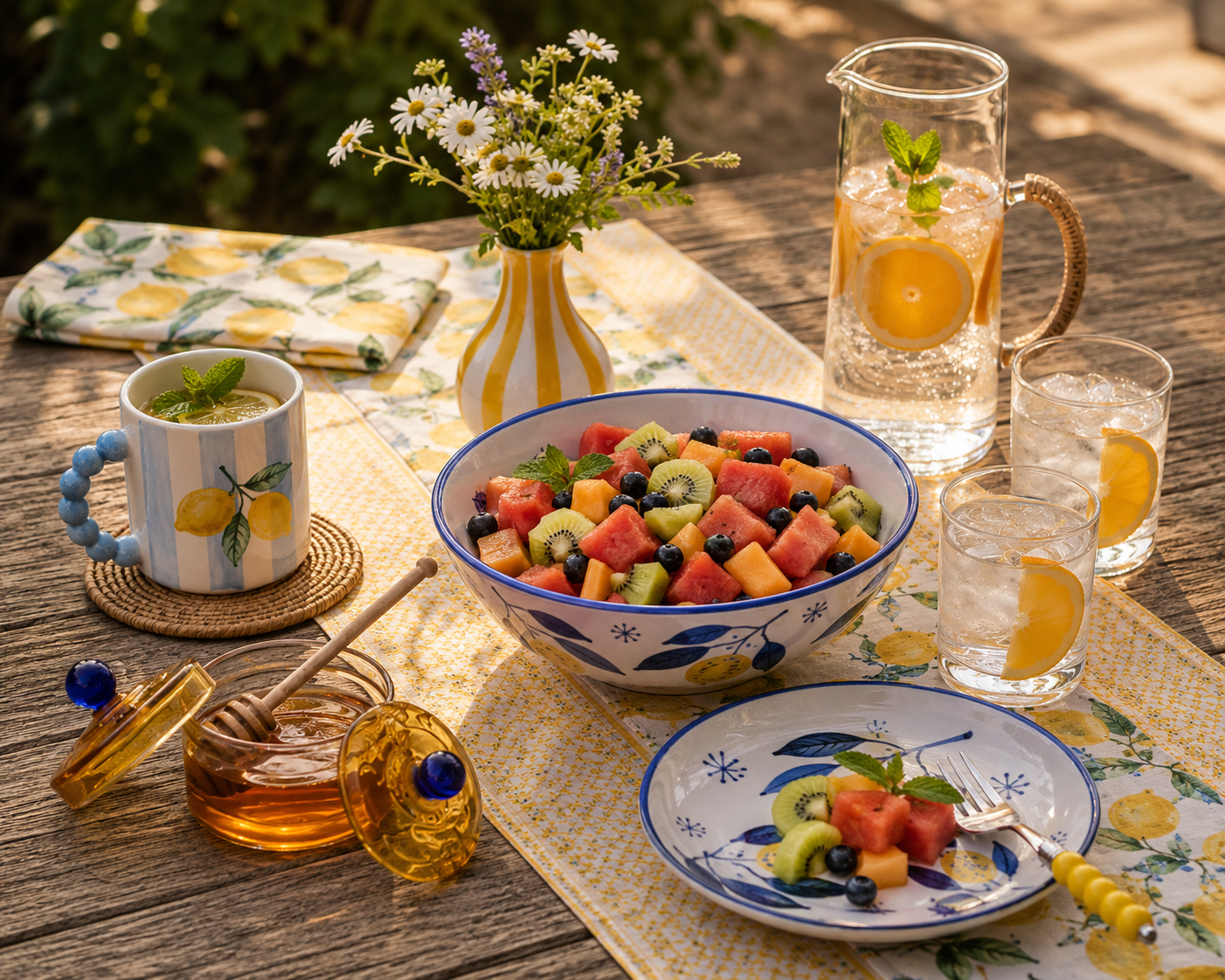
The table that stops you is the one that looks like someone made choices. A ceramic bowl that catches the light slightly differently from every angle. A textile runner where the pattern shifts just enough to remind you a person printed it. Small plates in the same colour family but not quite the same shade. Glasses that feel good in your hand because they were shaped by one.
That is what handmade brings to a summer table. Not perfection — consideration. Not coordination — personality. The sense that the person who set this table was paying attention.
This guide is built around that idea. How to create a summer entertaining table using handmade pieces that feel genuinely personal — starting with the anchor and building outward, layer by layer, until the whole thing comes together in a way that no store display ever could.
Whether you are hosting a long weekend lunch, a garden dinner, or just making Tuesday evening feel like something worth sitting down for — this is how to do it with handmade tableware that carries its own story to the table.
Section 1: The Anchor — Start With a Ceramic Serving Bowl
Every great table has an anchor. One piece that sets the tone for everything around it — that gives the eye somewhere to land and the arrangement somewhere to build from.
For a summer table, that anchor should be a ceramic serving bowl.
Not a decorative bowl that lives on a shelf. A working bowl — one that holds food, holds up to use, and still looks beautiful when it is empty at the end of the meal. A bowl that people reach toward before they even decide what they want.
Why ceramics work as the centrepiece
A ceramic bowl does something that a glass bowl or a metal bowl cannot. It grounds the table. The weight of it, the slight unevenness of a hand-thrown form, the way the glaze catches natural light differently from different angles — all of it reads as deliberate and warm in a way that manufactured tableware simply does not.
In summer, when tables often move outside and the light is brighter and harder, ceramics hold their own. They do not glare. They do not compete with the food. They sit quietly in the centre of the table and make everything around them look more considered.
Section 2: The Texture Layer — A Block-Printed Textile Runner
Once the anchor is in place, the next layer is texture.
A textile runner does more work on a summer table than most people realise. It is not just a surface covering or a way to protect the table. It is the layer that connects the individual pieces into a whole — the visual thread that runs underneath everything and makes the arrangement feel intentional rather than assembled.
For a handmade table, a block-printed textile runner is the right choice. Every other choice.
What block printing actually means
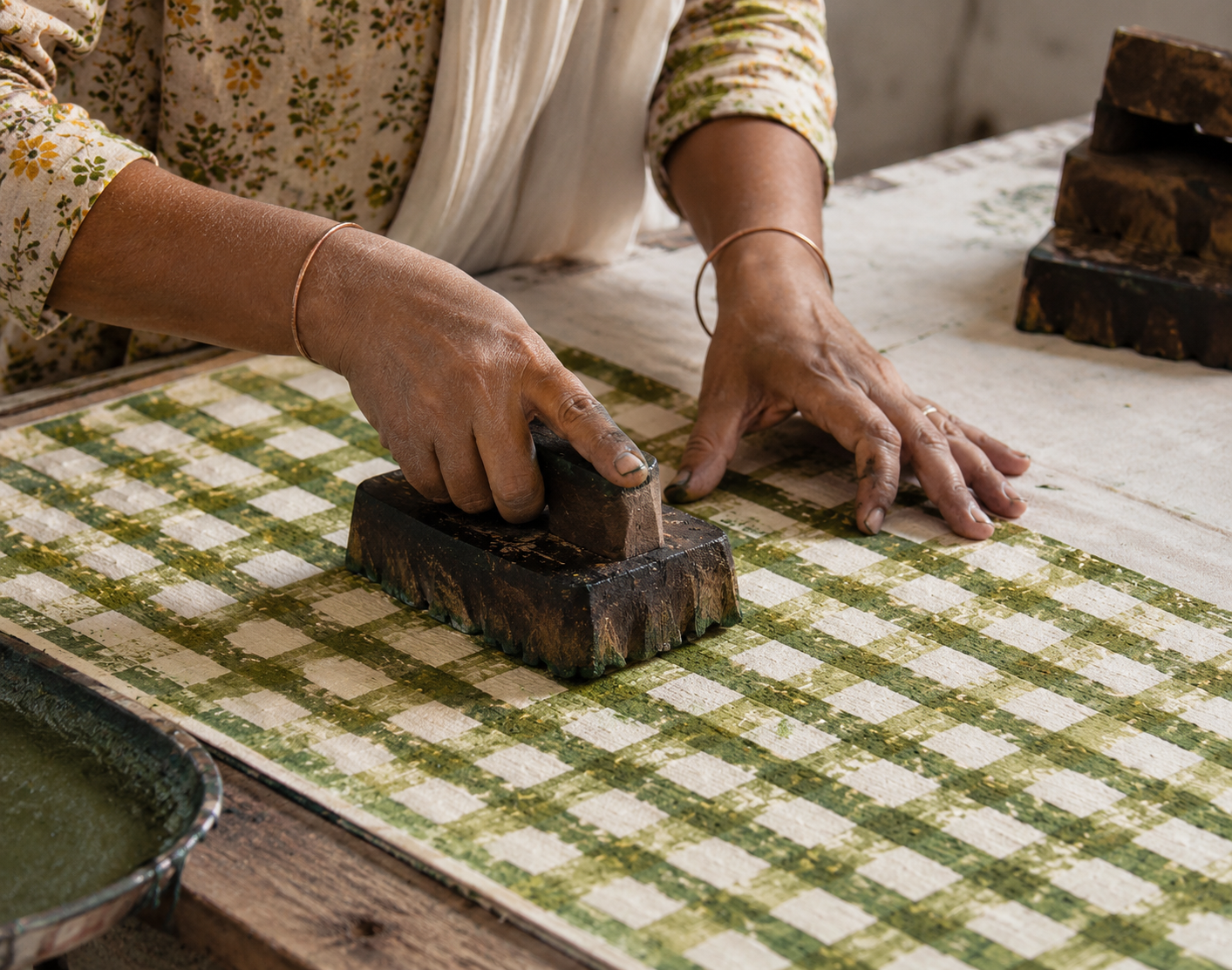
Block printing is one of India's oldest textile traditions. A wooden block — hand-carved with a specific pattern — is pressed into dye and then pressed onto fabric by hand, impression by impression, across the length of the cloth. Because each impression is made by a person rather than a machine, the pattern shifts slightly with each press. The repeat is not perfectly mechanical. The colour is not perfectly even.
This is exactly what makes it beautiful on a table. A block-printed runner has movement. It has variation. It has the quality of something that was made rather than manufactured — and that quality communicates itself to everyone who sits down at the table, even if they cannot articulate why.
What to look for in a textile runner
Pattern scale: For a summer table, look for patterns that are open rather than dense. A pattern with breathing room — a sprig repeat, a simple stripe, a loose geometric — will complement the tableware rather than compete with it. Dense, intricate patterns read better in winter when the table is more enclosed.
Colour: Natural undyed backgrounds work best in summer. Cream, ecru, unbleached cotton — these read as warm and seasonal without being literal about it. A pattern in one or two colours, ideally drawing from the palette of your anchor piece, ties the table together without matching it.
Length: A runner should extend slightly beyond the edges of the table on both ends — around 15 to 20 centimetres of overhang. This gives the table a relaxed, unhurried quality that works particularly well in outdoor summer settings.
Texture: Hand-woven or hand-block-printed textiles have a slight surface variation that machine-printed fabric does not. In natural light, this variation catches differently at different times of day — which is part of what makes a summer table feel alive rather than static.
How to layer it
Place the runner first, before any other pieces. Let it run the full length of the table and extend over both ends. Set your anchor bowl directly on top of it at the centre. If you are using individual place settings, the runner provides the visual axis that holds them together without requiring them to be perfectly symmetrical.
The textile should feel relaxed. If it is perfectly centred and perfectly straight, it will look like a display. A slight, intentional imperfection in the placement is part of the handmade aesthetic — and a summer table should always feel more like a meal than an occasion.
Section 3: The Detail Pieces — Small Plates and Painted Accents
The anchor holds the table. The textile connects it. The detail pieces are where the personality comes in.
Small plates, hand-painted bowls, accent pieces in unexpected colours — these are the elements that make a table feel genuinely considered rather than assembled from a set. And in a handmade context, they are also where the craft is most visible.
The logic of mixing pieces
The most interesting tables are not matched sets. They are considered combinations — pieces that share a colour family or a material language without being identical to each other. This is easier to achieve with handmade pieces than with manufactured ones, because each handmade piece already has its own slight individuality. They harmonise rather than match. And the result looks more curated than any matching set ever could.
For a summer table, the strategy is simple: choose pieces that share one quality — colour, material, or pattern language — and let everything else vary. A red-striped anchor bowl reads beautifully with aqua-accented plates and a leaf-motif side bowl because all three share the language of hand-painted detail, even though the colours and forms are different.
How to arrange the detail pieces
Place detail pieces in odd numbers — one, three, or five pieces in a cluster reads more naturally than two or four. Vary the height where possible: a bowl next to a plate next to a small tumbler creates more visual interest than a flat arrangement of identical forms.
Leave space between pieces. A crowded table looks busy; a table with breathing room looks considered. In summer especially, when the mood is supposed to be relaxed and generous, the space between things is as important as the things themselves.
Section 4: The Drinks Situation — Summer Outdoor Drinking Done Right
A summer table is not complete without the drinks situation sorted.
This sounds obvious, but the choice of glass or tumbler has more impact on the feel of a table than most people give it credit for. A heavy, formal wine glass on an outdoor summer table creates a dissonance — it belongs to a different kind of occasion. What a summer table needs is something that feels easy. Something you can hold with one hand while you talk. Something that looks good full or empty, and that survives the inevitable moment when someone puts it down on an uneven surface.
The case for a ceramic tumbler outdoors
Ceramic tumblers are underused in outdoor summer entertaining, and they should not be. They keep cold drinks cooler for longer than glass. They do not sweat the way glass does in summer heat. They are heavier and more stable on outdoor surfaces. And they look, on a handmade summer table, exactly right.
The tactile quality of a ceramic tumbler — the slight roughness of an unglazed exterior, the weight in the hand, the way the lip meets your mouth differently from a machine-made glass — is part of the pleasure of drinking from one. It is the kind of thing that guests notice and comment on without quite being able to say why.
Building the drinks corner
If you are entertaining more than four people, consider a dedicated drinks corner on a side table or a tray — a cluster of tumblers, a jug of water or iced drinks, a few small bowls of ice. This arrangement does two things: it gives guests somewhere to go when they want a refill without interrupting the table, and it creates a second visual moment in the space that extends the handmade aesthetic beyond the main table.
Read more
What Makes Handmade Different: A Founder's Honest Perspective
Summary: Casa Amarosa was founded to bridge the gap between India's rich artisan traditions and modern consumers seeking meaningful, handcrafted products. The article explores the difference betwee...
Read more